Why is the declination angle to a geostationary satellite
POSITIVE in the Southern Hemisphere and
NEGATIVE in the Northern Hemisphere?
Astronomers have defined declination as follows:
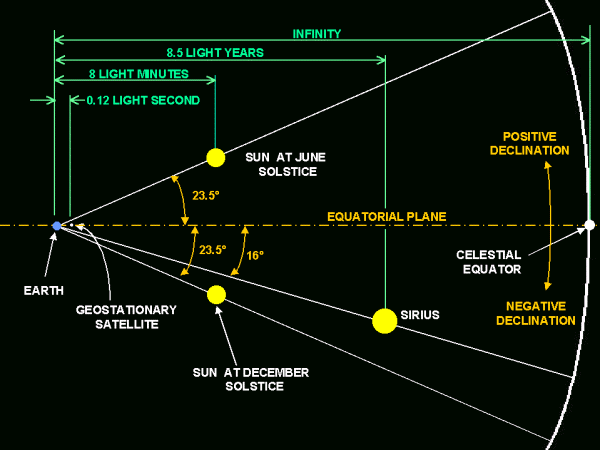
Any astronomical body north of the Celestial Equator has positive declination. Example: the star Polaris (the "Pole Star") is at declination +90° (approximately), which puts it almost directly above the North Pole.
Any astronomical body south of the Celestial Equator has negative declination. Example: the star Sirius (the "Dog Star") is at declination -16° (approximately). It rises in the east and sets in the west, but it's always 16° below the Celestial Equator.
The following sketch illustrates the situation. Note that:
The Geostationary Satellite lies in the earth's equatorial plane. At the scale of this drawing, the declination appears to be 0 degrees.
The Sun's declination varies throughout the year. This, of course, is why we have seasonal variations in temperature.
Sirius is always -16°.
EARTH, VIEWED FROM A POINT DIRECTLY ABOVE THE EQUATOR
(FROM A VERY LONG WAY AWAY) (NOT TO SCALE)
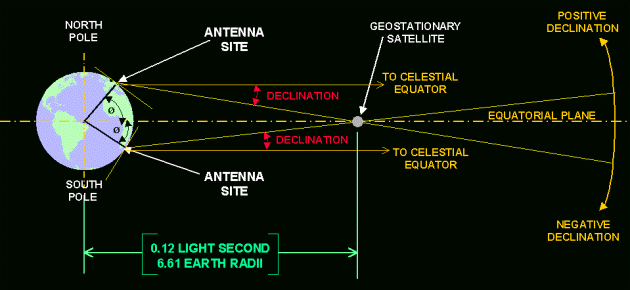
Now let's zoom in toward the earth. Note that:
An antenna located in the northern hemisphere must be aimed slightly "down" (south) to view the satellite. The line-of-sight to the satellite crosses the Equatorial Plane and arrives at infinity south of the Celestial Equator. Hence, its declination angle is negative.
An antenna located in the southern hemisphere also must be aimed slightly "down" (north) to view the satellite. The line-of-sight to the satellite crosses the Equatorial Plane and arrives at infinity north of the Celestial Equator. Hence, its declination angle is positive.
EARTH, VIEWED FROM A POINT DIRECTLY ABOVE THE EQUATOR
|